Othello
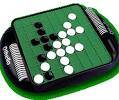
Othello is played on a 8x8 grid with each side having 32 discs that are either black or white. Whoever has the black discs goes first. The board initially has two black discs and two white discs in the 4 center squares and they are placed diagonally. Every time you move, your newly placed disc must sandwich the other color disc with the newly placed disc and a disc of the same color. All discs between them will be turned into your color discs. If you cannot make a move that does this, you have to pass your turn and your opponent gets to move again. The game ends when both sides do not have any legal moves. Whoever has the most discs of the same color wins.
Game link - https://www.eothello.com/
History: It is based on reversi, which was developed in England in 1880 by Lewis Waterman. It used an 8x8 board but it had loose rules and many unofficial variants. In 1971, Goro Hasegawa established official rules, starting position, and patented the game. Tsukuda Corporation mass produced the game in Japan where it became popular. Tokyo hosted the first World Othello Championship in 1977.
Checkers
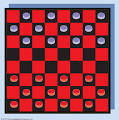
Checkers is played on a 8x8 grid with the setup as shown on the right. The player with the darker pieces always goes first. Normal pieces can only go 1 square at a time onto a dark square. If the opponent's piece is in front of you and the space behind it is empty, you must jump your piece over your opponent's piece to capture it. If you get another opportunity to capture another piece, it is automatically your move again and you have to capture it. If you have the option to capture multiple pieces, you can choose which to capture. When a piece reaches the opposite side of the board, it becomes a king and it will be able to move backwards. You win if you capture all of your opponent's pieces or if they do not have any legal moves left
Game link - https://www.247checkers.com/
History: Traces its roots to Alquerque in Middle East/Egypt. It was on a 5x5 board and had pieces that jumped over others in order to capture them. In France, it was moved onto a standard chess board. William Payne wrote the first official rules text in 1756. It became known as draughts in England and checkers in North America.
Connect 5/Gomoku
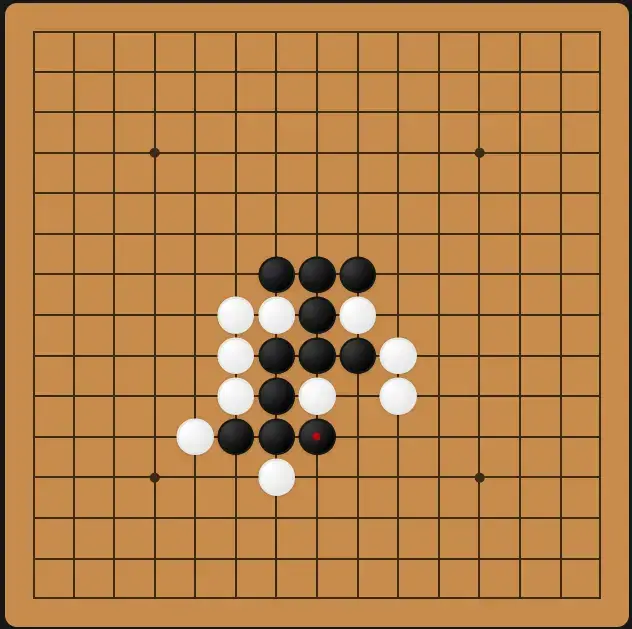
Connect 5 is played on an 15x15 or 19x19 board. One person will have black discs and the other will have white discs. The person with the black discs usually goes first. The discs are placed on the intersections, not on the empty spaces. Each person will take turns. Whoever gets a string of exactly 5 of the same color discs horizontally, vertically, or diagonally wins. If the board is filled and no one has a string of 5 same color discs, the game is a draw.
Game link - https://papergames.io/en/gomoku
History: Originated in China over 2000 years ago. It spread and became popular in Japan and Korea. In the 19th century, it was introduced to Western countries under the name Gobang. In 1993, computer scientist L. Victor Allis proved that black was guaranteed to win with optimal play from the very beginning. The methods used to force a win for black were banned in the professional version of the game called Renju.
Rock Paper Scissors
Rock paper scissors is a game played between two people with their hands. Each player has to release their hand at the same time in three shapes, rock, paper, and scissors, with the objective to be victorious over the other player. Rock beats scissors, paper beats rock, and scissors beat paper. Now it may seem like this is just a game of luck but there are actually tricks to gain an advantage. If you win, switch to the next move (Rock -> Paper -> Scissors). If you lose, switch to what beats what your opponent just played. If your opponent played the same move twice in a row, they may be more likely to play something else. If they are intentionally playing the same move again, you can either play the move that beats that or if you aren't sure, play the same move.
Senet
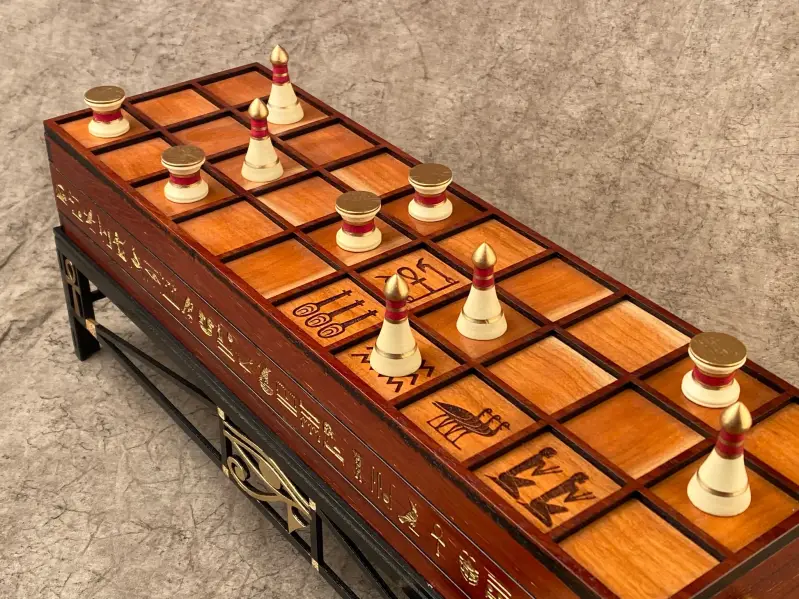
Senet is the earliest board game with documental history about it. It was created by the Egyptians and was designed as a journey throughout the afterlife. It is played with a 30 square board in a 3x10 arrangement. Each player has 5 pieces, and the goal is to get all the pieces off the board (past the 30th square). For a player's turn, 4 casting sticks are thrown, and the number of flat sides determines the move. One or four flat sides means to take one and four turns and take another turn again. Two and three sides mean to take 2 or 3 turns and 0 flat sides mean to move 5 squares and take another turn. You can only move one piece by the number casted and if the square you are supposed to land on is taken by another piece, you swap places with that piece. Pieces cannot be swapped if they are protected by being adjacent to another piece form the same player or 3 in a row. There are also special squares. On square 15, it is the house of rebirth and cannot be swapped here. Square 26 is the house of happiness and you must have landed on this square in order to be able to have the piece leave the board. square 27 is the house of water and if you land on it, you have to move back to square 15. Square 28 requires you roll a 3 to exit the square, square 29 requires you to exit the square with a 2, and square 30 requires a 1 to pass.
Chinese Chess
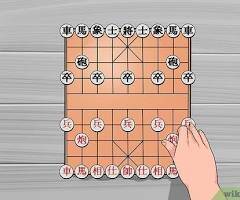
Just like chess, the goal is the checkmate the opponent's king but in this game it is called the general. The board is a 9-vertical by 10-horizontal line grid. The pieces sit on the intersections of the lines. The blank space in the middle of the board is called the river. The palace is a 3x3 area on each side shown by the x. Red always moves first. The general can only move up, down, left, and right and cannot leave the palace. Generals cannot face each other directly on an open file unless there is a piece in the way. The advisor moves one point directly and also cannot leave the palace. The elephant can only move two points exactly diagonally and cannot cross the river. It can be blocked if a piece is on the middle point. The horse moves one space orthogonally (up, down, left right) then diagonally. It can be blocked if the first movement is blocked. The chariot moves vertically and horizontally (like a rook in normal chess). The cannon moves like a chariot but in order to capture an enemy piece, there must be only one piece (either ally or enemy) in the way. The soldier moves one point forward but after it crosses the river, it can also move one point sideways. They cannot promote. Unlike a stalemate in chess, the player who cannot make any legal moves loses. Players cannot give perpetual checks or chase an unprotected piece.